
"Until Scarlett was able to furnish Aunt Pitty’s house as it had been before the war…she had no intention of having guests in her home—especially prominent guests, such as Melly had.
General John B. Gordon, Georgia's great hero, was frequently there with his family. Father Ryan, the poet-priest of the Confederacy, never failed to call when passing through Atlanta. He charmed gatherings there with his wit and seldom needed much urging to recite his 'Sword of Lee' or his deathless 'Conquered Banner,' which never failed to make the ladies cry."
--Gone with the Wind, Chapter XLI
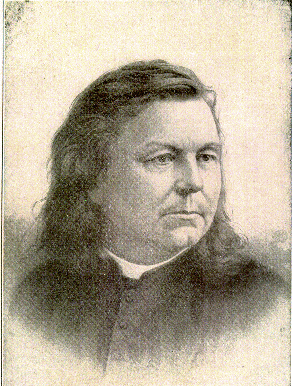 |
| Father Abram Joseph Ryan |
To list the things that make Margaret Mitchell a great writer is a pretty futile endeavor as it's best just to say "Everything" and move on to more mysterious matters... like do Rhett and Scarlett reconcile, what's so special about Marietta anyway, or just how much gaudy jewelry can you fit in one jewelry box? But as I never let reason get in the way of a chance to talk about GWTW or praise its author, I have an item to add to the "What makes MM so gifted?" list.
And here it is: as we've seen in her references to the Leyden House, the Governor's Mansion, and elsewhere, MM was especially adept at blending historical reality into the fictional narrative of Gone with the Wind, embedding her characters firmly and convincingly within a very unique moment in American history. Yet another nice example of this lies in the quote above, where the quite real Father Ryan attends the gatherings of the charming (but of course fictional) Melanie Wilkes. And thus today we're naturally looking into this Father Ryan character because a) he actually was a rather important figure in the Reconstruction-era South, b) he has a pretty sweet title going on with his Poet-Priest moniker and c) anyone who knowingly sports a hairstyle like this has got to have led an interesting life, right?
Born in 1838 to Irish immigrants, Abram Joseph Ryan spent his early years in Hagerstown, Maryland before moving with his family to Norfolk, Virginia and then St. Louis, Missouri. After completing his religious studies, he was ordained a Roman Catholic priest on September 12, 1860. Yet the decision to dedicate his life to the service of God was not without heartache for young Abram, as he had fallen in love with a devout Catholic girl, mysteriously known to the history books only as "Ethel." Despite their affection for each other, Abram and Ethel felt called to different paths and went their separate ways--he became a priest, she a nun. Yet Father Ryan would never forget her and references to Ethel, sometimes mournful, sometimes idealistic, appeared regularly in his later poetry.
Father Ryan then began his career in ministry, serving a number of short stints between 1861 and 1863 in Perryville, Missouri, Lewiston, New York and LaSalle, Illinois. Why the short stays? Some scholars believe Ryan, a Southerner by background and personal sympathy, had started to sneak off from his clerical duties to provide chaplain services on the sly to the Confederacy as early as 1862, hence causing the Catholic Church to reassign him multiple times in retribution.
Ryan was reassigned (yet again) to religious service in Tennessee in late 1863 or early 1864--an arrangement that at last seemed to suit him just fine, as he continued to provide chaplain services to the Confederate army at battles nearby, including at the Battle of Franklin (oh yes- Father Ryan could have met Rhett Butler too!).
Yet Father Ryan's fame and literary significance would only came after the war. Following the surrender of General Lee at Appomattox, he wrote what would become his most famous poem, "The Conquered Banner":
“I wrote 'The Conquered Banner' at Nashville, Tennessee one evening soon after Lee’s surrender, when my mind was engrossed with the thought of our dead soldiers and our dead Cause. It was first published in the New York Freeman’s Journal. I never had any idea that the poem, written in less than an hour, would attain celebrity status. No doubt the circumstances of its appearance lent it much of its fame. In expressing my own emotions at the time, I echoed the unuttered feelings of the Southern people; and so 'The Conquered Banner' became the requiem of the Lost Cause."--Father Ryan's recollections, excerpted from Furl That Banner: The life of Abram J. Ryan, Poet-Priest of the South
"The Conquered Banner" was published on June 24th 1865 and Father Ryan does not exaggerate when he speaks of its (and his, it should be added) instantaneous popularity. The poem was immediately embraced as, well, the banner of the fallen Southern war effort and catapulted him into prominence in the Southern post-war society.
In fact, Father Ryan is often credited with a significant role in establishing the cult of the Lost Cause, through his prolific outpouring of poetry filled with passionate and elegiac descriptions of the Confederacy and the South. He was one of the earliest adopters of the "Lost Cause" phrase, first using it in an address (ironically and probably intentionally) on July 4 in Nashville, Tennessee. Known for his charisma, his deep mysticism, and his white-hot fervor for all things Southern, he was (no surprise) a passionate opponent of Reconstruction--a theme he explored in depth through his journal The Banner of the South, first published in 1868 from his new home in Augusta, Georgia, where he had relocated after a relatively long stay (for him, anyway) in Tennessee between 1864-1867.
The journal was ostensibly a Church periodical, but it operated with a strong pro-Southern, anti-Reconstruction stance, typical of Father Ryan's sensibilities. Yet it never pays to pigeonhole someone. For although Father Ryan was one of the fiercest critics of Reconstruction and the North, he eventually put aside his sectional bias (long before, it should be added, many of his equally fervent Southerner compatriots did) and welcomed reconciliation with the North. The turning point for Father Ryan was the epidemic of yellow fever in 1878, when he was moved by the North's spirit of generosity in assisting the South with the sick. His changed opinions are on display in his poem "Reunited":
Purer than thy own white snow,
Nobler than thy mountains' height;
Deeper than the ocean's flow,
Stronger than thy own proud might;
O Northland! to thy sister's land
Was late thy mercy's generous deed and grand.
We close our discussion of Father Ryan where we began it--in the context of MM's reference to him in GWTW. Following the jump, you'll find complete lyrics for his two poems mentioned in the book, "The Conquered Banner" and "The Sword of Robert Lee." Of course, it must be noted that MM's allusion to Father Ryan attending Melanie Wilkes' gatherings does more than just offer a hint of historical accuracy--it works as yet another way to tie Melanie Wilkes to the values of the Old South. For if "The Conquered Banner" was the South's emblem of its lost way of life, Melanie herself is that very emblem within Gone with the Wind. Perhaps it's no surprise, then, that Mitchell, in her final reference to Melanie and all she stood for employs a mournful nostalgic tone that would be right at home in the writings of Father Ryan:
Late Update: Be sure to check out the comments to find some additional insights on Father Ryan from Donald Beagle, author of Poet of the Lost Cause: A Life of Father Ryan."She could not wholly understand or analyze what he was feeling, but it seemed almost as if she too had been brushed by whispering skirts, touching her softly in a last caress. She was seeing through Rhett's eyes the passing, not of a woman but of a legend—the gentle, self-effacing but steel-spined women on whom the South had builded its house in war and to whose proud and loving arms it had returned in defeat."--Gone with the Wind, Chapter LXII

